 By Colin Foster
Updated November 2026
Parents shopping for explorations early learning toys usually want something that does more than fill an afternoon. They want toys that build counting, sorting, letter sounds, and fine motor control in a way a young child can handle without frustration. This list covers five toys that fit that need, grouped by skill and age so you can match them to your child. Each pick was reviewed against its listing details, the skills it targets, the materials and piece counts the manufacturer states, and the kinds of feedback owners commonly post about durability, age fit, and how much adult help is needed. No product here was tested in a lab or used in our home, so treat the notes as a research summary rather than a hands-on review.
Our top picks at a glance
- 1
 TOP CHOICEBest overallSkillmatics Phonics Sorter – Vowel Sorting Preschool Activity, Learning ToyView on Amazon
- 2
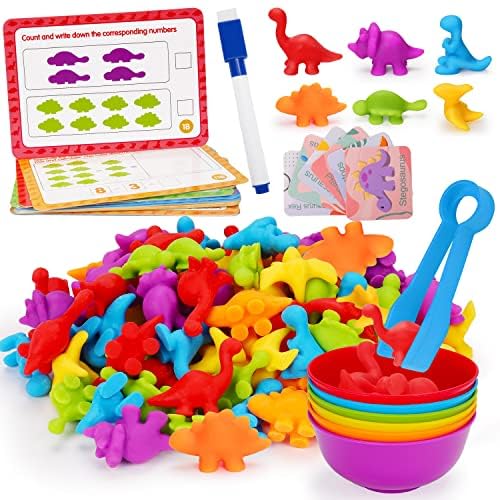 TOP CHOICEBest for counting and dinosaur playKids Manipulatives Preschool Learning Activities Counting Dinosaurs Montessori ToysView on Amazon
- 3
 TOP CHOICEBest for farm-themed matchingThe Original Peekaboo Learning Farm – Finger Puppets, Counting and SortingView on Amazon
- 4
 Best for toddlers under threePeekaboo Learning Jungle – Toddler Montessori Toys, Stacking Shape, Sorting and MatchingView on Amazon
- 5
 Best for language buildingBuilding Language and Matching Games Set with 6 Sorting Mats and 36 Everyday ObjectsView on Amazon
Our Top Picks
Quick Comparison
| Product | Best for | Key feature |
|---|---|---|
| Skillmatics Phonics Sorter | Letter sounds and early reading | Vowel sorting by short vowel sound |
| Kids Manipulatives Counting Dinosaurs | Counting and fine motor practice | Dinosaur-themed manipulatives for sorting and counting |
| The Original Peekaboo Learning Farm | Matching and early sorting | Finger puppet set for counting and matching play |
| Peekaboo Learning Jungle | Toddlers from 18 months | Stacking and shape sorting in 10 pieces |
| Building Language and Matching Games Set | Vocabulary and matching | 6 sorting mats with 36 everyday object pieces |
Skillmatics Phonics Sorter – Vowel Sorting Preschool Activity, Learning Toy
Montessori Phonics, Short Vowel Sounds, Phonemic Awareness, Early Reading, Pre-K to Grade 1, Christmas Gift Ages 4, 5, 6, 7 Skillmatics Phonics Sorter – Vowel Sorting Preschool Activity, Learning Toy
Best for: Letter sounds and early reading readiness
This is aimed at children around ages 4 to 7 who are starting to connect letters with sounds. It suits families who want a structured, phonics-focused activity rather than open-ended play, and it works well for pre-K children moving toward kindergarten reading goals.
Key specs
- Focus: short vowel sounds and phonemic awareness
- Listed age range: roughly 4 to 7 years
- Activity type: sorting by vowel sound
Pros
- Targets a specific early reading skill, which makes it easy to see progress
- Sorting format gives children a clear goal and immediate feedback
- Works as a short, focused session of ten to fifteen minutes
Cons
- Only useful once a child knows at least some letters
- Limited value for toddlers or children who have not started letter work
Bottom line: A strong choice for a preschooler or kindergartner who is starting phonics and needs guided practice with vowel sounds.
Kids Manipulatives Preschool Learning Activities Counting Dinosaurs Montessori Toys
Kids Manipulatives Preschool Learning Activities Kindergarten Educational Sensory Fine Motor Toys for Kids Ages 3-5 4-8 Counting Dinosaurs Montessori Toys for 3 4 5 Years Old Boys Girls
Best for: Counting and fine motor practice for dinosaur fans
Intended for children around ages 3 to 8, this set fits families who want hands-on counting and sorting with a theme children already enjoy. It is a practical option for building pincer grip and number recognition at the same time.
Key specs
- Listed age range: roughly 3 to 8 years
- Theme: counting dinosaurs with Montessori-style manipulatives
- Skills: counting, sorting, fine motor control
Pros
- Dinosaur theme keeps interest for children who resist worksheet-style counting
- Small pieces encourage the pincer grasp used later for writing
- Can be extended into simple addition or grouping games
Cons
- Small pieces are a choking hazard for children under three
- Works best with an adult nearby for counting prompts
Bottom line: Good for preschoolers and young kindergartners who like animals and need practice with counting and hand control.
The Original Peekaboo Learning Farm – Finger Puppets, Counting and Sorting
Finger Puppets, Counting and Sorting, Matching Activity, Fine Motor Play, Montessori Set, Early Skills, Toddler Toy Learning Resources The Original Peekaboo Learning Farm
Best for: Matching and early sorting with farm animals
This set is aimed at toddlers and preschoolers who are learning animal names, matching, and simple counting. Parents who want a portable, low-setup activity for car rides or waiting rooms may find it useful.
Key specs
- Format: finger puppets with matching and counting activities
- Theme: farm animals
- Skills: matching, counting, sorting, fine motor play
Pros
- Portable and requires no table or floor space
- Animal names and sounds add vocabulary practice
- Easy for an adult to play alongside a toddler
Cons
- Small finger puppets can be lost or mouthed by younger children
- Less challenging once a child has mastered basic matching
Bottom line: A practical pick for toddlers who love animals and parents who want a travel-friendly matching activity.
Peekaboo Learning Jungle – Toddler Montessori Toys, Stacking Shape, Sorting and Matching
Toddler Montessori Toys, Stacking Shape, Sorting And Matching Skill, Educational Games, 10 Pieces, Ages 18 Months+ Learning Resources Peekaboo Learning Jungle
Best for: Toddlers from 18 months with shape sorting and stacking
This suits the youngest end of the range. Parents of toddlers who are beginning to stack, sort by shape, and match simple pieces will find the skill steps manageable.
Key specs
- Listed age: 18 months and up
- Piece count: 10 pieces
- Skills: stacking, shape sorting, matching
Pros
- Appropriate starting point for children under two
- Stacking and shape sorting build early spatial reasoning
- Small set is easy to store and clean up
Cons
- Only 10 pieces limits variety over time
- Older preschoolers may outgrow it quickly
Bottom line: Best for toddlers starting out with shape and stacking play, especially families who want a simple first Montessori-style set.
Building Language and Matching Games Set with 6 Sorting Mats and 36 Everyday Objects
Building Language and Matching Games Set with 6 Sorting Mats and 36 Everyday Objects Pieces Special Education Classroom,Sorting Toys for Toddlers 1-3
Best for: Vocabulary building and matching in a structured set
This set targets toddlers and young preschoolers who are building vocabulary and learning to categorize everyday objects. It is also commonly used in special education and classroom settings, which may make it a good fit for families who want more structure.
Key specs
- Components: 6 sorting mats and 36 everyday object pieces
- Listed age range: roughly 1 to 3 years
- Skills: language, matching, categorizing
Pros
- Everyday objects connect play to real vocabulary
- Six mats give a clear structure for sorting sessions
- Useful for children working on categories and labels
Cons
- Many small pieces need to be counted and stored after each use
- Can feel repetitive for children who want more variety
Bottom line: A solid choice for families focused on language development who want a structured matching set with real-world objects.
Buying Guide
Match the Toy to the Skill You Want to Build
Start with one or two skills you want to target this month, such as counting to 10, letter sounds, or naming animals. A toy that does one thing well is usually more useful than a large set that does many things loosely. Phonics sorters suit children who already know some letters, while matching sets suit those still building vocabulary.
Good picks for this: Skillmatics Phonics Sorter, Building Language and Matching Games Set
Check the Age Range Against Choking Hazards
Many manufacturers list an age range, but small parts are the real safety question. For children under three, look for pieces larger than the test cylinder used by safety standards, and supervise any set with small pieces. Finger puppets and small manipulatives need extra attention with toddlers who still mouth objects.
Good picks for this: Peekaboo Learning Jungle, The Original Peekaboo Learning Farm
Consider Piece Count and Storage
A set with 36 pieces and six mats takes more time to set up and clean up than a 10-piece set. Count how many minutes you realistically have per session. Sets with clear storage or small, countable pieces are easier to keep organized and less likely to disappear.
Good picks for this: Building Language and Matching Games Set, Peekaboo Learning Jungle
Think About Theme and Motivation
Children often engage longer with a theme they already love, whether that is dinosaurs, farm animals, or jungle animals. A familiar theme can turn a counting task into a game. If your child loses interest quickly, pick the set whose theme matches their current favorite animals.
Good picks for this: Kids Manipulatives Counting Dinosaurs, The Original Peekaboo Learning Farm
Look at Fine Motor Demands
Small manipulatives build the pincer grasp used later for writing, but tasks that are too fine can frustrate younger children. Watch how your child handles pieces during the first session. If they struggle to pick up items, choose a larger-piece set and return to smaller pieces in a few months.
Good picks for this: Kids Manipulatives Counting Dinosaurs, Peekaboo Learning Jungle
Plan for Durability and Care
Plastic and wood components hold up differently over time. Owners frequently mention that thin plastic pieces can crack and that cardboard mats wear at the corners. Wipe components with a damp cloth and mild soap, let them air dry, and store them in a bin to extend their life.
Good picks for this: Skillmatics Phonics Sorter, Building Language and Matching Games Set
Decide How Much Adult Involvement You Can Offer
Some sets work as independent play, while others need a parent to model language, count out loud, or prompt sorting rules. If you have limited time for guided play, choose a set with clear picture cues. If you can sit alongside your child, a language-focused set will get more out of each session.
Good picks for this: Building Language and Matching Games Set, Skillmatics Phonics Sorter
FAQ
What age are explorations early learning toys meant for?
Age ranges vary by product in this list, from about 18 months for the Peekaboo Learning Jungle to around 7 years for the phonics sorter. Always check the manufacturer’s listed age and consider your own child’s stage, since readiness matters more than the printed number.
How do I know if a toy is safe for a toddler?
Look for pieces that are too large to fit through a choke tube, and supervise any play with small components. The U.S. Consumer Product Safety Commission publishes guidance on small parts and age labeling. If you have a specific safety concern, consult your pediatrician.
Can these toys help with school readiness?
Sorting, counting, matching, and letter-sound games build skills that support kindergarten readiness, including number sense and early literacy. They work best as part of regular, short play sessions rather than one-time activities.
How long should a session last?
For toddlers, five to ten minutes is often enough before attention drifts. Preschoolers can usually manage ten to fifteen minutes. Stopping while a child still wants to play tends to keep them coming back.
Which pick is best for a child who is not yet reading?
The Building Language and Matching Games Set and the Peekaboo Learning Farm are better fits for non-readers, since they rely on objects and pictures rather than letter sounds.
Do I need to play with my child, or can they use these alone?
Toddlers usually benefit from an adult modeling the task and naming objects. Older preschoolers may be able to work independently for short stretches, especially with sorting mats or puzzle-style sets.
Conclusion
For phonics and early reading, the Skillmatics Phonics Sorter is the most focused choice. For counting with a dinosaur theme, the Kids Manipulatives set fits preschoolers well. Families with toddlers under three should look at the Peekaboo Learning Jungle or the Peekaboo Learning Farm, keeping small-part safety in mind. For vocabulary and categorizing everyday objects, the Building Language and Matching Games Set offers the most structure. Match the toy to the skill your child is working on now, and rotate sets as their abilities grow.
Sources
- Small parts rules, age labeling, and choking hazard guidance for toys (cpsc.gov)
- Child development research on early language, motor skills, and learning in young children (nichd.nih.gov)
- Pediatric guidance on play, early learning, and toy safety for children (aap.org)
Related reading
- Wooden vs Plastic Early Learning Construction Toys: Which Is Better? (2026)
- Toys for Learning Shapes: 6 Types That Build Early Geometry Skills (2026)
- Toys for Learning Numbers: 6 Ways to Build Early Math Skills at Home
About Colin Foster
Colin Foster is part of our editorial team and reviews and edits our early learning at home guides, checking product details against manufacturer specifications and owner feedback.


