 By Colin Foster
Updated November 2026
Choosing learning toys for infants can be harder than it sounds. Babies under a year old change fast, and a toy that holds a six-month-old’s attention may be useless by eight months. Parents also want toys that are safe to mouth, easy to clean, and genuinely useful for building skills rather than just making noise. This guide compares seven well-regarded options across the first eighteen months. Our selection criteria were age range, the skills each toy targets (grasping, sensory exploration, cause and effect, tummy time, and early motor skills), safety and materials, durability, and the consistency of owner feedback. This is a research-based list built from manufacturer specifications and patterns in owner reviews, not hands-on testing.
Our top picks at a glance
- 1
 TOP CHOICEBest overallOKOOKO 6 Pack Soft Baby BookView on Amazon
- 2
 TOP CHOICEBest for stacking and graspingFisher-Price Baby's First Blocks & Rock-a-Stack Toy SetView on Amazon
- 3
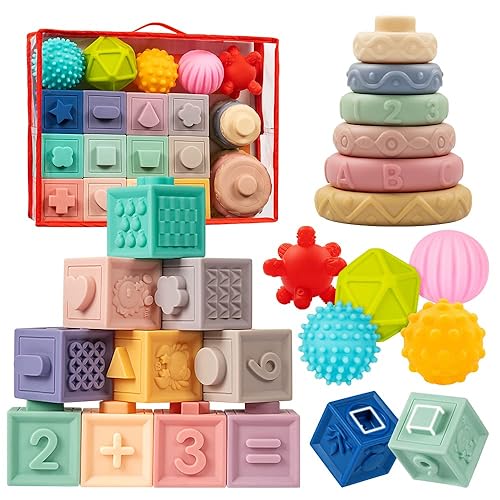 TOP CHOICEBest for sensory play on a budgetBaby Toys 6-12 Months Montessori SetView on Amazon
- 4
 Best for music and cause and effectFisher-Price Laugh & Learn Smart Stages PuppyView on Amazon
- 5
 Best for early language and animalsMs. Rachel Sensory Learning FarmView on Amazon
- 6
 Best for crawling and pushingiPlay, iLearn Baby Press to Go Car ToysView on Amazon
- 7
 Best for tummy timeYeeeasy Inflatable Tummy Time Water Play MatView on Amazon
Our Top Picks
Quick Comparison
| Product | Best for | Key feature |
|---|---|---|
| OKOOKO 6 Pack Soft Baby Book | Newborns and bath time | Washable, high-contrast soft books |
| Fisher-Price Baby’s First Blocks & Rock-a-Stack | Stacking and grasping | Ten shapes for ring stacking |
| Baby Toys 6-12 Months Montessori Set | Sensory play on a budget | Stacking blocks and teethers |
| Fisher-Price Laugh & Learn Smart Stages Puppy | Music and cause and effect | Five activations with music and lights |
| Ms. Rachel Sensory Learning Farm | Early language and fine motor | Eight animal scenes with crinkle flaps |
| iPlay, iLearn Baby Press to Go Car Toys | Crawling and pushing practice | Friction-powered push car |
| Yeeeasy Inflatable Tummy Time Water Play Mat | Tummy time | Inflatable water-filled play mat |
OKOOKO 6 Pack Soft Baby Book
Washable, Nontoxic, High Contrast Baby Book, Educational Learning Toy, Baby Bath Toys, Soft Books for Babies OKOOKO 6 Pack Soft Baby Book, Bath Toy, Soft Cloth Book, Crinkle Book
Best for: Newborns and bath time
This set suits parents of newborns through toddlers who want safe, washable items that can go in the tub or stroller. High-contrast patterns are designed to suit early visual development.
Key specs
- Pack of 6 soft cloth books
- Labeled as washable and suitable for bath use
- High-contrast black, white, and bold color designs
- Crinkle and soft-touch elements
Pros
- Machine washable and safe to use in water
- Lightweight and easy to carry in a diaper bag
- Good variety in one pack
Cons
- Soft books offer less interactive play than mechanical toys
- Small text and images may not hold older infants’ interest for long
Bottom line: A strong first purchase for families who want safe, washable reading and sensory items from birth.
Fisher-Price Baby’s First Blocks & Rock-a-Stack Toy Set
Bucket of 10 Shapes, Ring Stacking Activity, For Infants & Toddlers Ages 6+ Months (Amazon Exclusive) Fisher-Price Baby’s First Blocks & Rock-a-Stack Toy Set
Best for: Stacking and grasping
Designed for infants six months and older, this set works well for babies developing their pincer grasp and learning that objects can be placed, removed, and stacked.
Key specs
- Recommended for ages 6 months and up
- Bucket of 10 shapes for ring stacking
- Designed for infants and toddlers
Pros
- Builds grasping, release, and hand-eye coordination
- Bright, distinct shapes support early shape recognition
- Storage bucket keeps pieces together
Cons
- Small pieces need supervision for babies who still mouth objects
- Older toddlers may outgrow it quickly
Bottom line: A good choice for parents of babies from about six months who are ready to practice stacking and fine motor control.
Baby Toys 6-12 Months Montessori Set
Baby Toys 6-12 Months, Montessori Toy for Babies 6-12 Months, Incl Stacking Building Blocks & Soft Infant Teething Toys & Sensory Balls for Toddlers 0-3-6-9-12 Month
Best for: Sensory play on a budget
This set bundles stacking blocks, teething toys, and sensory balls, making it a practical pick for families who want variety in one purchase. It fits the Montessori-inspired approach of open-ended, hands-on exploration.
Key specs
- Labeled for babies roughly 6 to 12 months
- Includes stacking blocks, soft teethers, and sensory balls
- Multiple textures and shapes in one set
Pros
- Wide variety for sensory exploration
- Teethers help during teething
- Good starting set for rotating toys
Cons
- Quality can vary across multi-piece sets, so check materials on arrival
- Some items may be too small for babies who still mouth toys
Bottom line: Best for parents who want many textures and shapes to rotate for sensory play without buying separate items.
Fisher-Price Laugh & Learn Smart Stages Puppy
Electronic Learning Toy, Music & Lights, 5 Activations, Infants & Toddlers Ages 6+ Months Fisher-Price Laugh & Learn Smart Stages Puppy Baby Plush Toy
Best for: Music and cause and effect
An electronic plush toy for infants and toddlers from six months, this puppy gives babies a clear link between pressing a button and a response, which is a core early learning concept.
Key specs
- Recommended for ages 6 months and up
- Electronic learning toy with music and lights
- Five activations
Pros
- Clear cause-and-effect feedback
- Soft plush body suits babies who like cuddling
- Music and lights hold attention during floor play
Cons
- Electronic toys can be loud, so check volume settings
- Batteries will need replacing over time
Bottom line: A solid choice for parents who want an interactive toy that rewards babies for pressing, touching, and listening.
Ms. Rachel Sensory Learning Farm
8 Animal Scenes with Crinkle Flaps, Develops Fine Motor Skills, Infant Toys for Babies Ages 3 Months to 18 Months Ms. Rachel Sensory Learning Farm, Soft Foldable Baby Book with Plush Cow
Best for: Early language and fine motor
This soft foldable book with a plush cow targets babies from three to eighteen months. Crinkle flaps and animal scenes encourage fine motor practice and early labeling of familiar animals.
Key specs
- Recommended for ages 3 to 18 months
- Eight animal scenes
- Crinkle flaps and soft foldable pages
- Includes a plush cow
Pros
- Combines reading, texture, and plush play
- Crinkle flaps support fine motor development
- Animal scenes support early vocabulary
Cons
- Plush attachments should be checked for secure fit
- Scenes are fixed, so play is less open-ended
Bottom line: A good pick for parents who want reading and sensory play in one soft item for the first year and a half.
iPlay, iLearn Baby Press to Go Car Toys
Infant Play Vehicle Set, Push Go Friction Car, Montessori Toy for 6-9-12-18 Months, 1st Birthday Gifts for 1-2 Years Old Girl iPlay, iLearn Baby Press to Go Car Toys for Toddlers 1-3, 1 Yr Old Boy Gif
Best for: Crawling and pushing practice
A friction-powered push car suits babies who are beginning to crawl, cruise, or walk. Pushing the car forward encourages hand, arm, and balance skills.
Key specs
- Listed for ages 6 to 18 months and older toddlers
- Push-and-go friction mechanism
- Part of a vehicle set
Pros
- Supports crawling, cruising, and first steps
- No batteries required for the push-and-go action
- Simple cause and effect
Cons
- Friction mechanisms can wear with rough use
- Less useful once a child is walking confidently
Bottom line: Best for families with a crawling or cruising baby who needs a sturdy push toy for practice.
Yeeeasy Inflatable Tummy Time Water Play Mat
Yeeeasy Tummy Time Water Mat丨Inflatable Tummy Time Water Play Mat for Babies, Infants and Toddlers 3 to 24 Months Promote Development Toys Baby Toys essentials and Gifts
Best for: Tummy time
Tummy time builds neck, shoulder, and core strength. This inflatable water mat gives babies a reason to lift their heads and reach, turning a routine task into play.
Key specs
- Labeled for babies 3 to 24 months
- Inflatable water-filled play mat
- Designed for tummy time and water play
Pros
- Encourages head lifting and reaching during tummy time
- Can be used on a floor or in a shallow setting with supervision
- Gives babies a changing surface for exploration
Cons
- Must be inflated and filled carefully, and drained after use
- Never leave an infant unattended on any water-based item
Bottom line: A useful tummy time tool for parents who want to make daily floor time more engaging.
Buying Guide
Match the Toy to the Baby’s Developmental Stage
Newborns respond best to high-contrast images and soft textures. From about four to six months, babies start reaching and grasping. Around six months and up, stacking, ring toys, and simple cause-and-effect toys become useful. Between nine and eighteen months, push toys and toys that encourage crawling or early walking gain value. Check the age range on the package, and treat it as a guide rather than a strict rule.
Good picks for this: OKOOKO 6 Pack Soft Baby Book, Fisher-Price Baby’s First Blocks & Rock-a-Stack Toy Set
Check Materials and Safety
Babies explore by mouthing, so materials matter. Look for toys labeled as nontoxic, BPA-free where applicable, and made from smooth, durable fabric or plastic without loose parts. Avoid toys with small detachable pieces for babies who still mouth objects. The U.S. Consumer Product Safety Commission publishes guidance on toy safety, including small-parts hazards for young children.
Good picks for this: OKOOKO 6 Pack Soft Baby Book, Ms. Rachel Sensory Learning Farm
Consider Size and Choking Hazards
A common guideline is to check whether a toy fits inside a toilet paper tube, which approximates the size of a small-parts hazard for children under three. Use this as a quick check, not a guarantee, and inspect toys regularly for loose eyes, buttons, or cracks.
Good picks for this: Baby Toys 6-12 Months Montessori Set, Fisher-Price Baby’s First Blocks & Rock-a-Stack Toy Set
Look for Sensory Variety
Babies learn through touch, sound, sight, and movement. Toys with different textures, crinkle sounds, and contrasting colors support sensory development. Rotating a few sensory toys every week keeps interest high without buying a large collection.
Good picks for this: Baby Toys 6-12 Months Montessori Set, Ms. Rachel Sensory Learning Farm
Think About Cause and Effect
Toys that respond when a baby presses, shakes, or pulls help them understand that their actions have results. Electronic toys can offer this feedback, but simple mechanical toys work well too. Choose toys with clear, predictable responses.
Good picks for this: Fisher-Price Laugh & Learn Smart Stages Puppy, Fisher-Price Baby’s First Blocks & Rock-a-Stack Toy Set
Support Motor Development
Tummy time, crawling, pulling up, and walking all benefit from the right toys. Floor mats, push toys, and toys placed just out of reach encourage movement. Supervise closely during any floor play, and never leave an infant unattended on a water-based item.
Good picks for this: Yeeeasy Inflatable Tummy Time Water Play Mat, iPlay, iLearn Baby Press to Go Car Toys
Plan for Durability and Care
Babies drop, chew, and drag toys. Fabric toys should be machine washable or easy to wipe clean. Hard plastic toys should be checked regularly for cracks. Electronic toys need battery compartments that are secured with a screw. Keeping a simple cleaning routine helps toys last longer and stay hygienic.
Good picks for this: OKOOKO 6 Pack Soft Baby Book, Fisher-Price Laugh & Learn Smart Stages Puppy
FAQ
What are the best learning toys for infants under six months?
Soft, high-contrast books and sensory items are the most appropriate for this age. Babies at this stage respond to bold patterns, soft textures, and sound. The OKOOKO soft baby book set is one option that fits this range.
When should I start giving my baby stacking toys?
Many stacking toys are labeled for babies six months and older, when grasping becomes more deliberate. Check the manufacturer’s age recommendation, and supervise closely for any baby who still mouths objects.
Are electronic learning toys good for infants?
They can be, in moderation. Electronic toys offer clear cause and effect and music, but babies also benefit from unstructured, non-electronic play. Keep volume low and mix electronic toys with simple sensory items.
How often should I rotate infant toys?
Many parents rotate a small set of toys every few days or weekly. Rotation keeps play fresh and lets you choose toys that match the skills your baby is currently practicing.
How do I clean infant toys safely?
Follow the care label. Machine-washable fabric toys can usually be cleaned on a gentle cycle. Hard plastic toys can be wiped with mild soap and water. Air-dry toys completely before giving them back to your baby.
Is tummy time important for infant learning?
Tummy time supports neck, shoulder, and core strength, which lead to rolling, sitting, and crawling. The American Academy of Pediatrics recommends supervised tummy time from the first days of life, building up gradually. Talk with your pediatrician about any concerns with your baby’s development.
Conclusion
For most families, the OKOOKO soft baby book set is a practical starting point because it works from birth and is easy to clean. Families with babies around six months will likely get the most use from the Fisher-Price stacking set. Parents who want electronic cause-and-effect play should consider the Laugh & Learn puppy, while those with crawling babies may prefer the push car. The Yeeeasy tummy time mat suits families focused on early motor development, and the Montessori set and Ms. Rachel farm book offer variety for sensory and language play. Match the toy to your baby’s current skills, check safety labels, and rotate a few options to keep play engaging.
Sources
- Toy safety guidance, including small-parts and choking hazard information for young children (cpsc.gov)
- Pediatric guidance on tummy time, developmental milestones, and age-appropriate play (healthychildren.org)
- Developmental milestones for infants from birth through the first year (cdc.gov)
Related reading
- VTech Learning Toys for 2 Year Olds: How to Choose the Right Ones
- Toys for 3 Year Olds Learning: 5 Best Picks Compared (2026)
- Top Preschool Learning Toys: 7 Best Picks Compared (2026)
- Top 7 Learning Resources Numberblocks Toys for Preschool Math
- Top 5 Learning Toys for Kindergarten: Compared for Home Learning (2026)
About Colin Foster
Colin Foster is part of our editorial team and reviews and edits our early learning at home guides, checking product details against manufacturer specifications and owner feedback.


