By Audrey Hayes
Updated November 2026
Choosing materials for a homeschool preschool 4 year old can feel overwhelming, because the shelves are full of workbooks, manipulatives, and full curriculum guides that all promise school readiness. This list narrows the field to six options that cover the core areas most four-year-olds work on at home: counting, number sense, letter and number tracing, fine-motor cutting, and a structured pre-K plan for parents who want a sequence to follow. Each pick was evaluated on its listing details, the stated age range, the learning goal it targets, the format a four-year-old can use independently, and the feedback patterns owners tend to mention.
Our top picks at a glance
- 1
 TOP CHOICEBest overallMontessori Number Counting Block Toys for Kids, Educational Toys for 3View on Amazon
- 2
 TOP CHOICEBest for handwriting practiceReusable Writing Practice Activity Book for Toddlers Ages 3-5View on Amazon
- 3
 TOP CHOICEBest for early math workbooksPreschool Math Activity Book: Learn to Count, Number Tracing, Addition and SubtractionView on Amazon
- 4
 Best for fine-motor skillsScissor Skills Preschool Activity Book: Learn to Cut Lines, Shapes, Fruits, AnimalsView on Amazon
- 5
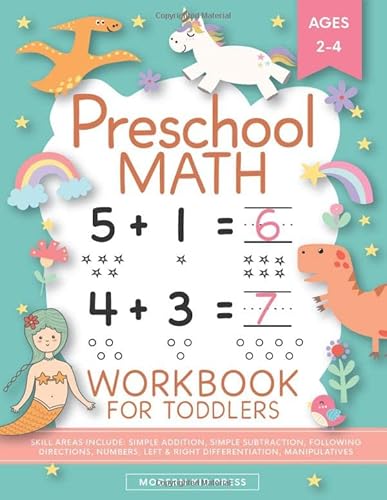 Best budget pickPreschool Math Workbook for Toddlers Ages 2-4View on Amazon
- 6
 Best for a full planHomeschooling Curriculum Guide – PRE-K: 3-4 years oldView on Amazon
Our Top Picks
Quick Comparison
| Product | Best for | Key feature |
|---|---|---|
| Montessori Number Counting Block Toys for Kids | Hands-on counting and number sense | Manipulatives for quantity and place value |
| Reusable Writing Practice Activity Book for Toddlers Ages 3-5 | Pencil control and letter formation | Reusable pages for repeated tracing |
| Preschool Math Activity Book: Learn to Count, Number Tracing, Addition and Subtraction | Structured early math practice | Covers counting through simple addition and subtraction |
| Scissor Skills Preschool Activity Book | Fine-motor and cutting practice | Cut-along lines of increasing difficulty |
| Preschool Math Workbook for Toddlers Ages 2-4 | Budget-friendly math introduction | Number tracing and matching activities |
| Homeschooling Curriculum Guide – PRE-K | Parents who want a full sequence | Complete home education structure for ages 3–4 |
Montessori Number Counting Block Toys for Kids, Educational Toys for 3-5 Year Old Boys Girls
Montessori Number Counting Block Toys for Kids, Educational Toys for 3-5 Year Old Boys Girls Christmas Birthday Gifts Preschool Math Manipulatives Learning Toys for Toddlers 2-4
For another angle, check out Chore Chart for 5 Year Olds: 7 Steps to One They'll Actually Use.
Best for: Hands-on counting and number sense
This set suits a four-year-old who learns best by touching and stacking. Parents who want to move beyond rote counting toward quantity matching will find it a useful addition to a homeschool preschool 4 year old routine.
Key specs
- Designed for children listed as ages 3–5
- Counting blocks for number recognition and quantity matching
- Montessori-style, self-correcting design
Pros
- Builds one-to-one correspondence through physical objects
- Works for solo play or a short guided lesson
- Reinforces number concepts without worksheets
Cons
- Small pieces need supervision with younger siblings
- Limited use once a child moves to written addition
Bottom line: A strong first purchase for a parent who wants concrete, tactile math before adding paper-based work.
Reusable Writing Practice Activity Book for Toddlers Ages 3-5
Reusable Writing Practice Activity Book for Toddlers Ages 3-5 – Educational Learning Toys for 3-4 Year Old – Toddler Gifts Preschool Learning Toys Workbook & Letter Tracing Books for Kids Ages 3-5
Best for: Pencil control and letter formation
Four-year-olds are often ready to trace letters and shapes with more control. A reusable format lets siblings or repeat sessions use the same pages without wasting material.
Key specs
- Listed for ages 3–5
- Reusable tracing pages for repeated practice
- Covers letter and number tracing with guided strokes
Pros
- Reusable pages reduce waste over a school year
- Progression moves from lines to letters
- Good for building the pencil grip needed for writing
Cons
- Reusable pages may need a wipe-off or dry-erase tool, depending on the format
- Less useful once a child can write independently
Bottom line: Best for families who want daily handwriting practice that resets easily between lessons.
Preschool Math Activity Book: Learn to Count, Number Tracing, Addition and Subtraction
Preschool Math Activity Book: Learn to Count, Number Tracing, Addition and Subtraction | Fun Educational Workbook for Kids | Toddler & Preschool Learning Activities for 3-5 Year Olds
Best for: Structured early math practice
For a parent who wants a clear math path, a workbook that moves from counting to simple operations gives a visible sequence. It works well as a weekly anchor in a homeschool preschool 4 year old schedule.
Key specs
- Listed for ages 3–5
- Covers counting, number tracing, addition and subtraction
- Workbook format for independent or guided work
Pros
- Clear progression from counting to basic operations
- Easy to use for short daily sessions
- Reinforces number formation alongside math concepts
Cons
- Operations may be early for some four-year-olds
- Requires pencil skills that some children are still building
Bottom line: A good fit for a child who already counts to 20 and is ready for the first ideas of adding and taking away.
Scissor Skills Preschool Activity Book: Learn to Cut Lines, Shapes, Fruits, Animals
Scissor Skills Preschool Activity Book: Learn to Cut Lines, Shapes, Fruits, Animals | Fun Cutting & Coloring Book for Kids | Preschool Learning Activities for 3-5 Year Olds
Best for: Fine-motor and cutting practice
Scissor control is a common goal for four-year-olds, and it supports hand strength needed for writing. This book gives a child a themed reason to cut.
Key specs
- Listed for ages 3–5
- Cutting lines, shapes, fruits and animals
- Combines cutting with coloring
Pros
- Builds bilateral coordination and hand strength
- Themed pages keep a four-year-old engaged
- Pairs well with a child-safe pair of scissors
Cons
- Requires a supervising adult for scissor use
- Pages are used up, so it is a one-time purchase
Bottom line: Ideal for a parent who wants to add a fine-motor block to the day without extra supplies.
Preschool Math Workbook for Toddlers Ages 2-4
Preschool Math Workbook for Toddlers Ages 2-4: Beginner Math Preschool Learning Book with Number Tracing and Matching Activities for 2, 3 and 4 year olds and kindergarten prep
Best for: Budget-friendly math introduction
This workbook targets a wider age band, so it can work as a gentle start for a four-year-old who needs more foundational practice before moving on.
Key specs
- Listed for ages 2–4
- Number tracing and matching activities
- Includes kindergarten-prep content
Pros
- Good starting point for beginners
- Matching activities build number-quantity links
- Budget-oriented option for families buying several books
Cons
- May feel easy for a confident four-year-old
- Less depth than a full structured curriculum
Bottom line: A practical choice for a child who needs review or is just beginning formal number work.
Homeschooling Curriculum Guide – PRE-K: 3-4 years old
Homeschooling Curriculum Guide – PRE-K: 3-4 years old – Complete Home Education Curriculum and Structure
Best for: Parents who want a full sequence
Parents who feel unsure how to organize a week often benefit from a guide that lays out a complete home education structure. This option suits the planner more than the hands-on learner.
Key specs
- Designed for ages 3–4
- Complete home education curriculum structure
- Guide format for planning across subjects
Pros
- Gives a ready-made framework for the week
- Reduces guesswork about what to teach next
- Useful reference alongside hands-on materials
Cons
- Still requires the parent to gather activities and supplies
- Not a workbook a child uses directly
Bottom line: Best for a parent building a homeschool preschool 4 year old plan from scratch.
Buying Guide
Match the Learning Goal to the Child
Start with what your four-year-old can already do. A child who counts to 10 but cannot yet trace numbers needs different materials than one who writes simple letters. Ask whether you need hands-on manipulatives, paper practice, or a planning tool.
Good picks for this: Montessori Number Counting Block Toys; Preschool Math Activity Book
Check the Age Range Carefully
Many preschool products list a span such as ages 2–4 or 3–5. Choose the range that matches your child’s current skills rather than the range that sounds most advanced. A product labeled for younger children can still help as review.
Good picks for this: Preschool Math Workbook for Toddlers Ages 2-4; Reusable Writing Practice Activity Book
Consider Fine-Motor Demands
Tracing, cutting and coloring all build the small muscles needed for writing. Look at whether the book asks for pencil control, scissor use, or both, and whether the pages are reusable for repeated practice.
Good picks for this: Scissor Skills Preschool Activity Book; Reusable Writing Practice Activity Book
Look at Format and Durability
Workbooks wear out quickly with daily use. Reusable pages, sturdy covers, and manipulatives made from thick, smooth material generally hold up better. Consider whether a child will use the item alone or with a parent.
Good picks for this: Montessori Number Counting Block Toys; Reusable Writing Practice Activity Book
Decide Between a Workbook and a Full Curriculum
Single workbooks are useful for targeted practice, while a curriculum guide provides a sequence for the whole week. Many families combine both, using a guide to plan and workbooks to practice.
Good picks for this: Homeschooling Curriculum Guide – PRE-K; Preschool Math Activity Book
Plan for Supervision and Safety
Small counting pieces and scissors both need an adult nearby, especially if siblings are present. Check that small parts are age-appropriate and store materials out of reach when not in use.
Good picks for this: Scissor Skills Preschool Activity Book; Montessori Number Counting Block Toys
Budget for Replacement Pages
Consumable workbooks are a one-time purchase, so consider how many children will use them. Reusable options spread the cost across a year or across siblings.
Good picks for this: Reusable Writing Practice Activity Book; Preschool Math Workbook for Toddlers Ages 2-4
FAQ
What should a homeschool preschool 4 year old learn?
Most four-year-olds work on counting to 20, recognizing numbers, beginning letter sounds, tracing shapes and letters, and using scissors. Social and self-care skills also matter. Treat these as general goals rather than a strict checklist.
How long should lessons last for a four-year-old?
Many early educators suggest short, focused sessions of about 10 to 20 minutes, separated by movement or play. Attention spans vary, so follow your child’s cues.
Do I need a full curriculum for homeschool preschool?
No. A full curriculum can help with planning, but many families use a few workbooks and hands-on materials instead. Choose whichever approach you can sustain consistently.
Are counting blocks better than workbooks?
They serve different purposes. Blocks build concrete understanding of quantity, while workbooks build written number formation and pencil control. Using both is common.
When should a four-year-old start tracing letters?
Many children begin tracing around this age, but readiness varies. If your child struggles with the pencil or gets frustrated quickly, start with lines and shapes before letters.
How do I know if the materials are working?
Look for steady progress over several weeks, such as counting higher, forming numbers more neatly, or cutting along a line with fewer breaks. If your child is consistently frustrated, simplify the material or consult an early childhood professional.
Conclusion
For a homeschool preschool 4 year old, the best choice depends on the learning goal. Montessori Number Counting Block Toys suit hands-on counting, while the Reusable Writing Practice Activity Book supports handwriting. The Preschool Math Activity Book provides a structured math path, and the Scissor Skills book builds fine-motor control. The Preschool Math Workbook for Toddlers offers a budget-oriented starting point, and the Homeschooling Curriculum Guide – PRE-K helps parents plan the whole week. Many families combine two or three of these for a balanced routine.
For more planning ideas, see Schedule for Homeschool Preschool: A Flexible Daily Plan That Works, Preschool Homeschool Set Up: A Step-by-Step Guide for Parents, and Preschool Homeschool Schedule Printable: A Step-by-Step Daily Routine Guide.
Sources
- Developmental milestones for children at age four, including motor and language skills (cdc.gov)
- Early learning resources and guidance on preschool readiness (ed.gov)
- Developmentally appropriate practice guidelines for young children
Related reading
- Preschool Homeschool Curriculum 2 Year Old: 6 Best Picks Compared (2026)
- Homeschool Preschool Schedule for 3 Year Olds: A Step-by-Step Guide
- 5 Best Homeschool a 5 Year Old Preschool Curriculums (2026): Our Picks
About Audrey Hayes
Audrey Hayes is part of our editorial team and reviews and edits our early learning at home guides, checking product details against manufacturer specifications and owner feedback.