By Colin Foster
Updated November 2026
Parents looking for learning toys for elementary students usually want something that supports school math without turning every afternoon into homework. The best options at this age tend to be hands-on manipulatives: fraction tiles, linking cubes, magnetic building sets and multiplication boards that let a child see a concept before memorizing it. In this guide, we compared five products on the criteria that matter most for home use: how clearly the set maps to common elementary math topics, how many pieces and activities it includes, how durable the materials appear to be, and how well it works for a range of ages and skill levels.
Our top picks at a glance
- 1
 TOP CHOICEBest overallElementary Math Manipulatives, Learning Toys, Number Centers for ClassView on Amazon
- 2
 TOP CHOICEBest for building number senseMath Manipulatives, Color Linking Cubes for Kids, Number Cube Toys, ClView on Amazon
- 3
 TOP CHOICEBest for learning fractionsFraction Magnets for Kids, Montessori Math Manipulatives Fraction LearView on Amazon
- 4
 Best for open-ended buildingColorful Magnet Stacking Toys Birthday Gift for Children STEM PreschooView on Amazon
- 5
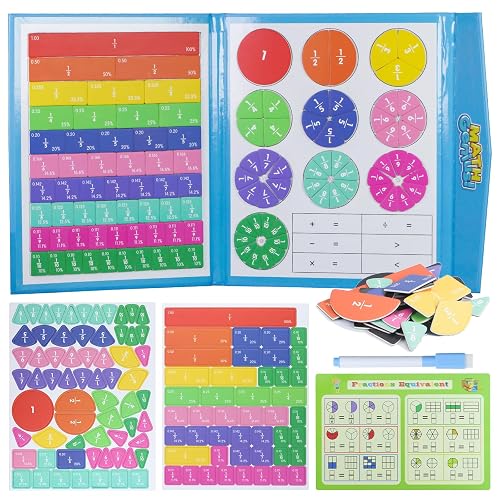 Best budget pickMagnetic Fraction Educational Puzzle with Fraction Tiles & Circles, MaView on Amazon
Our Top Picks
Quick Comparison
| Product | Best for | Key feature |
|---|---|---|
| hand2mind Multiplication Practice Board | Practicing multiplication facts | Board-based format for drilling times tables |
| Learning Resources MathLink Cubes Elementary Math Activity Set | Number sense and counting | Interlocking linking cubes for hands-on counting and patterns |
| Fraction Magnets Montessori Fraction Manipulatives | Learning fractions | Magnetic fraction tiles and circles for visual comparison |
| Colorful Magnet Stacking Toys STEM Construction Tiles | Open-ended building and spatial thinking | Magnetic tiles for 3D construction |
| Magnetic Fraction Educational Puzzle (Blue) | Budget-minded fraction practice | Fraction tiles and circles in a puzzle format |
Elementary Math Manipulatives, Learning Toys, Number Centers for Classroom, Multiplication Table Learning Activities hand2mind Multiplication Practice Board, Math Facts, Ages 7+
Elementary Math Manipulatives, Learning Toys, Number Centers for Classroom, Multiplication Table Learning Activities hand2mind Multiplication Practice Board, Math Facts, Ages 7+
Best for: Practicing multiplication facts and building fluency with times tables.
This board suits children around second through fourth grade who are moving from counting to memorizing multiplication facts. It works well for a parent who wants a structured, repeatable practice tool rather than open-ended play.
Key specs
- Designed for ages 7 and up, per the listing
- Focused on multiplication table practice and math facts
- Board format suited to classroom centers or home practice
Pros
- Clear focus on math facts, which is what many elementary teachers emphasize
- Easy to use independently once a child knows the routine
- Works for both home and classroom center settings
Cons
- Narrower in scope than a full manipulative set
- Less useful for younger children still learning to count
Bottom line: A strong choice for a child who needs focused multiplication practice and does well with repetition.
Math Manipulatives, Color Linking Cubes for Kids, Number Cube Toys, Classroom Counting Activity, Stem Learning Activities Learning Resources MathLink Cubes Elementary Math Activity Set
Math Manipulatives, Color Linking Cubes for Kids, Number Cube Toys, Classroom Counting Activity, Stem Learning Activities Learning Resources MathLink Cubes Elementary Math Activity Set
Best for: Building number sense, counting, and early operations.
Linking cubes are a classic manipulative in elementary classrooms. This set suits children who are still building a concrete understanding of quantity, addition and subtraction, or pattern recognition, and it works equally well for a younger sibling.
Key specs
- Color linking cube format for counting and grouping
- Listed as an elementary math activity set
- Suitable for classroom counting and STEM-style activities
Pros
- Interlocking cubes make grouping and place value easy to demonstrate
- Flexible for many activities, from patterns to simple word problems
- Familiar format that aligns with common classroom materials
Cons
- Cubes can scatter and need a storage container
- Less visual support for fractions compared with tile-based sets
Bottom line: Ideal for families who want one versatile set for counting, patterns and early arithmetic.
Fraction Magnets for Kids, Montessori Math Manipulatives Fraction Learning Toys for Elementary School Students Magnetic Fraction Manipulatives, Magnetic Fraction Tiles & Fraction Circles
Fraction Magnets for Kids, Montessori Math Manipulatives Fraction Learning Toys for Elementary School Students Magnetic Fraction Manipulatives, Magnetic Fraction Tiles & Fraction Circles
Best for: Learning fractions, equivalence and comparison.
Fractions are a common sticking point in upper elementary grades. Magnetic tiles and circles let a child physically line up halves, thirds and fourths on a whiteboard or fridge, which often makes comparison easier to grasp.
Key specs
- Magnetic fraction tiles and fraction circles, per the listing
- Montessori-style manipulatives aimed at elementary students
Pros
- Magnets stick to metal surfaces, so the display can stay up between sessions
- Visual comparison of fractions supports equivalence work
- Good match for the fraction units in most elementary math programs
Cons
- Limited use outside fractions compared with general cube sets
- Small pieces can be lost without a dedicated tray
Bottom line: The right pick for a child who is struggling with fractions or needs a visual anchor for the concept.
Colorful Magnet Stacking Toys Birthday Gift for Children STEM Preschool Educational Construction Tiles Set Magnetic Tiles Building Blocks for 3 4 5 6 7 8+ Years Old Boys Girls
Colorful Magnet Stacking Toys Birthday Gift for Children STEM Preschool Educational Construction Tiles Set Magnetic Tiles Building Blocks for 3 4 5 6 7 8+ Years Old Boys Girls
Best for: Open-ended building, spatial reasoning and STEM exploration.
This set is aimed at a wider age range than the other picks, from preschool through early elementary. It suits children who learn best by building and experimenting, and it can support geometry and symmetry ideas.
Key specs
- Listed for ages 3 through 8 and up
- Magnetic construction tiles for stacking and building
- Marketed as a STEM educational toy
Pros
- Works across a broad age range, useful for mixed-age households
- Encourages creative 3D building and spatial thinking
- Magnets make connections easy for young builders
Cons
- Less targeted to specific elementary math standards
- Magnetic pieces should be kept away from small children who might swallow them
Bottom line: Best for families who want a flexible building set that grows with the child.
Magnetic Fraction Educational Puzzle with Fraction Tiles & Circles, Math Manipulatives Montessori Learning Toys to Help Kids Learn Fractions and Build Early Math Skills (Blue)
Magnetic Fraction Educational Puzzle with Fraction Tiles & Circles, Math Manipulatives Montessori Learning Toys to Help Kids Learn Fractions and Build Early Math Skills (Blue)
Best for: Budget-minded fraction practice in a puzzle format.
This option takes the fraction focus of the magnetic sets and packages it as a puzzle, which some children find more inviting. It suits a family that wants a focused fraction tool without a larger investment.
Key specs
- Magnetic fraction tiles and circles, per the listing
- Blue color variant
- Montessori-style design aimed at early math skills
Pros
- Puzzle format adds a game-like element to fraction practice
- Covers the same core fraction concepts as larger sets
- Straightforward to set up and use at a kitchen table
Cons
- Fewer pieces than some larger manipulative collections
- Limited for topics beyond fractions
Bottom line: A sensible starting point for a child who needs fraction practice and responds to puzzles.
Buying Guide
Match the Set to the Math Topic
Start with what your child is working on in class. Counting and early addition suit cube sets, multiplication fluency suits drill boards, and fractions suit magnetic tiles and circles. Matching the tool to the current unit makes practice feel relevant instead of extra.
Good picks for this: Learning Resources MathLink Cubes Elementary Math Activity Set, Fraction Magnets Montessori Fraction Manipulatives
Check the Age Range Printed on the Box
Age labels from manufacturers are a useful starting point, though a child’s actual readiness matters more. Some sets are listed for ages 7 and up, while others cover a wider span. Treat the label as a guide and adjust based on how your child engages with the pieces.
Good picks for this: hand2mind Multiplication Practice Board, Colorful Magnet Stacking Toys STEM Construction Tiles
Count the Pieces and Note Their Size
A set with more pieces supports more activities, but larger pieces are easier for young hands to handle. Check whether the manufacturer lists a piece count. If small magnets or tiles are included, keep them out of reach of younger siblings.
Good picks for this: Magnetic Fraction Educational Puzzle (Blue), Learning Resources MathLink Cubes Elementary Math Activity Set
Look at Materials and Durability
Plastic cubes and tiles tend to hold up well to repeated handling, while magnets should be checked for a secure housing. Owners often report that sets stored in a dedicated tray last longer than those kept loose in a drawer.
Good picks for this: Learning Resources MathLink Cubes Elementary Math Activity Set, Colorful Magnet Stacking Toys STEM Construction Tiles
Think About Use: Practice Versus Exploration
Some children need structured practice, while others learn by building freely. A drill board fits the first need; open-ended tiles fit the second. Many families end up with one of each over time.
Good picks for this: hand2mind Multiplication Practice Board, Colorful Magnet Stacking Toys STEM Construction Tiles
Plan for Storage and Setup
Manipulatives are most useful when they are easy to reach. A shallow bin or tray for each set keeps pieces together and makes it simple to start a session in a few minutes. Magnetic sets also benefit from a metal surface such as a fridge or whiteboard.
Good picks for this: Fraction Magnets Montessori Fraction Manipulatives, Magnetic Fraction Educational Puzzle (Blue)
Consider Budget Against Expected Use
If a child will use a set daily for a school year, a fuller collection may pay off. If the goal is a short unit on one topic, a focused set can be enough. Think about how long you expect the toy to stay in rotation before deciding.
Good picks for this: Magnetic Fraction Educational Puzzle (Blue), hand2mind Multiplication Practice Board
FAQ
What are the best learning toys for elementary students?
Hands-on manipulatives such as linking cubes, fraction tiles and multiplication boards are among the most useful, because they make abstract math concepts concrete. The best choice depends on the topic your child is studying.
At what age should elementary students start using manipulatives?
Many children use manipulatives from kindergarten through fifth grade. Younger elementary students often benefit from counting cubes, while older students may use fraction tiles or multiplication boards.
Are magnetic fraction tiles good for learning fractions?
Magnetic tiles and circles let children compare and line up equal parts visually, which can help with equivalence. They work best alongside explanation from a parent or teacher.
How do I know if a manipulative set matches my child’s curriculum?
Check the topic your child is studying this month. If the set covers that skill, it is likely useful. Your child’s teacher can also suggest materials that align with class lessons.
Can one set cover all elementary math topics?
Most individual sets focus on a few areas, such as counting or fractions. Families often combine a general set with a focused one for specific skills.
Are magnetic toys safe for children?
Magnetic pieces can be hazardous if swallowed, especially for toddlers. Keep small magnets away from younger children and check the manufacturer’s age guidance and safety notes before use. Consult a pediatrician or product safety professional if you have concerns.
Should I buy a multiplication board or a cube set first?
If your child already understands what multiplication means and needs practice, a drill board fits. If they are still building number sense, a cube set is usually the better starting point.
Conclusion
Among these five learning toys for elementary students, the hand2mind Multiplication Practice Board suits focused fact practice, while the Learning Resources MathLink Cubes set offers the most flexibility for counting and early arithmetic. Families working on fractions will find the magnetic tile options, including the budget-minded blue puzzle, a practical place to start. The Colorful Magnet Stacking Toys set fits children who enjoy open-ended building across a wider age range. Match the tool to the topic your child is studying, and you will get more value from the time spent together.
Sources
- Federal education resources and guidance on elementary student learning and support (ed.gov)
- Consumer product safety information, including age labeling and small-parts warnings for children's toys (cpsc.gov)
- Mathematics teaching standards and guidance on hands-on math tools for elementary grades
Related reading
- VTech Learning Walker Toys R Us: How to Choose and Set Up the Right Walker
- VTech Learning Toys for 2 Year Olds: How to Choose the Right Ones
- VTech Electronic Learning Toys: How to Choose the Right Ones for Your Child
- Toys for 3 Year Olds Learning: 5 Best Picks Compared (2026)
- Top Preschool Learning Toys: 7 Best Picks Compared (2026)
About Colin Foster
Colin Foster is part of our editorial team and reviews and edits our early learning at home guides, checking product details against manufacturer specifications and owner feedback.